


In modern industrial automation, precision is no longer optional. Manufacturers need sensors that can detect tiny, transparent, reflective, or fast-moving objects without interruption. For automation equipment builders, semiconductor manufacturers, and electronic assembly lines, selecting the right Fiber optic sensor wholesale supplier directly affects production stability, equipment efficiency, and long-term operating costs.
As a professional industrial sensor manufacturer established in 2009, Huayifeng provides standardized and customized sensing solutions for automation, new energy, semiconductors, and electronic manufacturing industries. With nearly 100 patents and multiple international certifications, the company continues helping global B2B customers improve detection accuracy while reducing equipment downtime.
Why Fiber Optic Sensors Are Essential in Smart Manufacturing
Traditional photoelectric sensors often struggle in environments where objects are extremely small, transparent, reflective, or positioned in tight spaces. Fiber optic sensors solve these limitations by separating the sensing head from the amplifier, allowing more flexible and accurate detection.
Today, industrial buyers increasingly choose digital fiber optic sensors because they offer:
- Higher detection precision
- Faster response speed
- Better anti-interference capability
- Compact installation flexibility
- Stable detection under complex lighting conditions
- Lower long-term maintenance costs
As manufacturing lines become faster and more automated, these advantages become critical for maintaining consistent product quality.
Common Detection Problems in Industrial Applications
Many automation equipment manufacturers encounter the same operational challenges during production.
Unstable Detection of Transparent Objects
Transparent films, glass components, and thin packaging materials are difficult for ordinary sensors to detect consistently. False triggers can interrupt automated processes and increase rejection rates.
The FR-J20 Series from Huayifeng addresses this issue through adjustable light output. Operators can reduce emission intensity during close-range sensing, improving the detection stability of transparent and tiny objects.
Limited Installation Space
Modern automation equipment often contains compact internal structures. Bulky sensing devices create installation difficulties and reduce maintenance accessibility.
Fiber optic sensors offer flexible mounting options because the sensing fiber is compact and can fit into narrow spaces where conventional sensors cannot operate efficiently.
Frequent Operator Misoperation
On busy production floors, accidental parameter changes can disrupt equipment calibration and create unnecessary downtime.
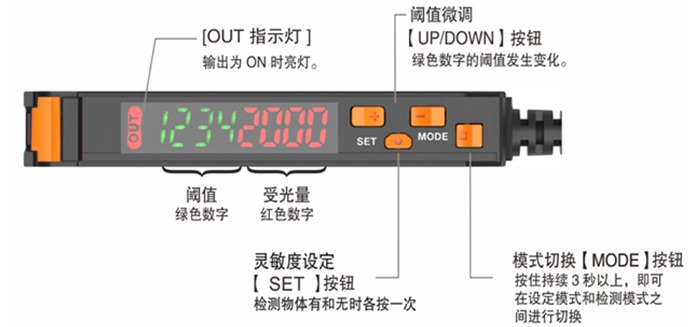
The FR-J20 Series includes:
- Key lock protection
- Simple button operation
- Dual display monitoring
- Built-in function menu
These features reduce operational mistakes while improving daily usability.
What Makes the FR-J20 Series Suitable for B2B Buyers
For industrial buyers, performance alone is not enough. Procurement teams also evaluate stability, scalability, maintenance requirements, and cost-performance balance.
Dual Digital Display Improves Efficiency
The FR-J20 Series uses two independent digital displays, allowing operators to simultaneously monitor:
- Reference values
- Incident light intensity
- Detection status
This design shortens setup time and simplifies troubleshooting during operation.
High-Speed Response for Fast Production Lines
Different manufacturing applications require different response speeds. The FR-J20 Series supports multiple switching frequencies:
- STD: 2kHz
- LONG: 25Hz
- HS: 10kHz
With a response time as fast as 25μs in HS mode, the sensor supports high-speed automation equipment where timing precision is critical.
Stable Performance in Harsh Industrial Environments
Industrial environments contain vibration, dust, fluctuating temperatures, and electrical interference. Therefore, durability becomes a key purchasing factor.
The FR-J20 Series provides:
- Surge protection
- Reverse polarity protection
- Short-circuit protection
- Shock resistance up to 500 m/s²
- Vibration resistance from 10~55Hz
These protections help manufacturers reduce unexpected failures and maintenance costs.
Key Factors Buyers Should Compare Before Purchasing
Selecting the right supplier involves more than comparing prices. Experienced procurement teams usually evaluate several important factors before making a purchasing decision.
Certification and Compliance
Reliable industrial sensor suppliers should comply with international standards.
Huayifeng has obtained:
- ISO9001 Quality Management Certification
- ISO14001 Environmental Certification
- ISO45001 Occupational Health Certification
- CE Certification
- ROHS Compliance
These certifications help international buyers simplify qualification procedures and ensure regulatory compliance.
Production Capacity and Technical Support
A supplier with strong R&D capability can better support OEM and customized projects.
Huayifeng integrates:
- Research and development
- Manufacturing
- Application engineering
- Technical support
- Customized product services
This integrated capability is especially valuable for automation equipment manufacturers requiring tailored sensing solutions.
Cost-Performance Ratio
Many buyers focus only on unit pricing. However, unstable sensors often create hidden costs through downtime, maintenance, and defective products.
The FR-J20 Series improves cost efficiency through:
- Structural optimization
- Automated production processes
- Long operational lifespan
- Reduced maintenance frequency
As a result, customers achieve better total ownership value rather than simply lower purchase prices.
Typical Industrial Applications of Fiber Optic Sensors
Semiconductor Manufacturing
Semiconductor production requires extremely precise positioning and object detection. Tiny wafers and reflective surfaces demand highly sensitive sensors with fast response capability.
The FR-J20 Series supports stable operation in these demanding environments.
Electronic Manufacturing
PCB assembly lines, SMT production, and connector manufacturing often involve miniature components moving at high speed.
Fiber optic sensors help maintain:
- Accurate positioning
- Stable counting
- Reliable object presence detection
- High-speed synchronization
New Energy Equipment
Battery manufacturing and photovoltaic production involve transparent films and reflective materials that challenge traditional sensors.
Adjustable light output helps improve detection reliability throughout these production processes.
Packaging Automation
High-speed packaging systems require compact sensors capable of handling various materials and product sizes without repeated recalibration.
The FR-J20 Series offers flexible switching modes including:
- Light ON
- Dark ON
- ON-delay timer
- OFF-delay timer
- ONE SHOT timer
These functions improve compatibility across different packaging automation scenarios.
Fiber Optic Sensor vs Traditional Photoelectric Sensor
Many buyers compare fiber optic sensors with standard photoelectric sensors before purchasing.
| Feature | Fiber Optic Sensor | Traditional Photoelectric Sensor |
|---|---|---|
| Detection Accuracy | Very high | Moderate |
| Small Object Detection | Excellent | Limited |
| Flexible Installation | Strong | Limited |
| Transparent Object Detection | Stable | Less reliable |
| Compact Space Adaptation | Excellent | Average |
| Interference Resistance | High | Moderate |
For advanced industrial automation, fiber optic sensors typically provide better long-term performance and operational flexibility.
Why More Global Buyers Choose Huayifeng
Established in 2009, Huayifeng has become a trusted industrial sensing partner for automation, semiconductor, and electronic manufacturing companies.
The company continues investing in:
- Product innovation
- Automated manufacturing
- Patent development
- Environmental compliance
- Global customer support
Its mission, “Let the world feel China’s contribution,” reflects a long-term commitment to industrial sensing innovation and global manufacturing development.
Beyond product performance, B2B customers value stable supply chains, technical reliability, and responsive engineering support. These factors increasingly influence supplier selection in the global automation industry.
Conclusion
Choosing the right Fiber optic sensor wholesale supplier is essential for improving automation reliability, reducing maintenance costs, and supporting long-term manufacturing growth. Industrial buyers must evaluate not only product specifications, but also supplier certifications, technical capabilities, customization support, and production consistency.
With nearly 100 patents, comprehensive certifications, and extensive automation industry experience, Fiber optic sensor wholesale supplier Huayifeng delivers cost-effective sensing solutions designed for modern industrial applications. From semiconductor manufacturing to electronic assembly and smart automation systems, the FR-J20 Series provides the precision, stability, and flexibility required by today’s competitive production environments.