



A reliable Color sensor helps you detect product differences, identify color marks, and maintain consistent inspection results on automated production lines. When packaging materials, labels, components, or conveyor boxes have similar shapes but different colors, conventional object detection may not provide enough information. Huayifeng develops industrial sensing solutions that help you address these challenges with the CR5H, CR6, and CR7 color sensor series.
Founded in 2009, Huayifeng integrates R&D, production, sales, and application services in Shenzhen, China. The company serves automation equipment manufacturers in industries including new energy, semiconductors, electronics manufacturing, packaging, logistics, and robotics.
What Is a Color Sensor?
A color sensor detects differences in the color or reflected light of a target and converts the result into a usable detection signal. This makes it suitable when you need to distinguish products, detect printed color marks, or identify changes between materials moving through an automated process.
Huayifeng’s CR Series uses different optical configurations to support various detection requirements:
- CR5H: Simple color mark and color detection with RGB three-color LED technology.
- CR6: Intelligent digital color sensor with multiple detection methods and fiber optic compatibility.
- CR7: White light color sensor designed for wider visible-light detection and longer detection distances.
These configurations allow you to select a color sensor for automation according to the target material, installation space, detection distance, and required inspection method.
CR5H, CR6 and CR7 Color Sensor Comparison
| Model | Light Source | Detection Distance | Key Feature | Typical Application |
|---|---|---|---|---|
| CR5H | RGB three-color, 4-element LED | 10 ± 3 mm / 25 ± 4 mm | Color mark and color mode | Packaging, product sorting |
| CR6 | RGB three-color, 4-element LED | Fiber-dependent | Digital display and multiple modes | Industrial automation |
| CR7 | White LED | 30–500 mm / 30–70 mm / fiber-dependent | White light and dual-spot options | Packaging, logistics, assembly |
The CR5H supports 2-point teaching for color mark mode and 1-point teaching for color mode, with a response time of approximately 35 μs in Color Mark Mode and 80 μs in Color Mode.
The CR6 provides automatic color matching and timer functions from 1 ms to 9999 ms, while the CR7 supports AUTO, C, CI, and MARK modes. CR7 models also achieve detection distances up to 500 mm, depending on the model.
How to Choose an Industrial Color Sensor
Choosing the right industrial color sensor depends on your target, installation conditions, and production speed. You can use the following process:
- Identify the detection target.
Determine whether you need to detect a printed color mark, distinguish product colors, or identify different materials. - Measure the installation distance.
For short-range detection, CR5H can provide 10 mm or 25 mm detection options. For longer-distance applications, selected CR7 models support 30–500 mm. - Check the available installation space.
If the sensor must fit into a narrow machine structure, fiber optic configurations can help you position the sensing head more flexibly. - Select the detection mode.
Choose color mark detection when tracking printed marks and color detection when distinguishing different target colors. - Confirm the output and environmental requirements.
CR5H and CR7 models provide NPN/PNP output options, and protection ratings vary by model; confirm the specific model’s output type and IP rating before final selection.
Color Sensor Applications in Real Industrial Scenarios
A color sensor for packaging machines can detect registration marks on packaging film and help the machine maintain accurate positioning during continuous production. The CR5H’s compact housing and digital setting interface make it suitable where installation space is limited.
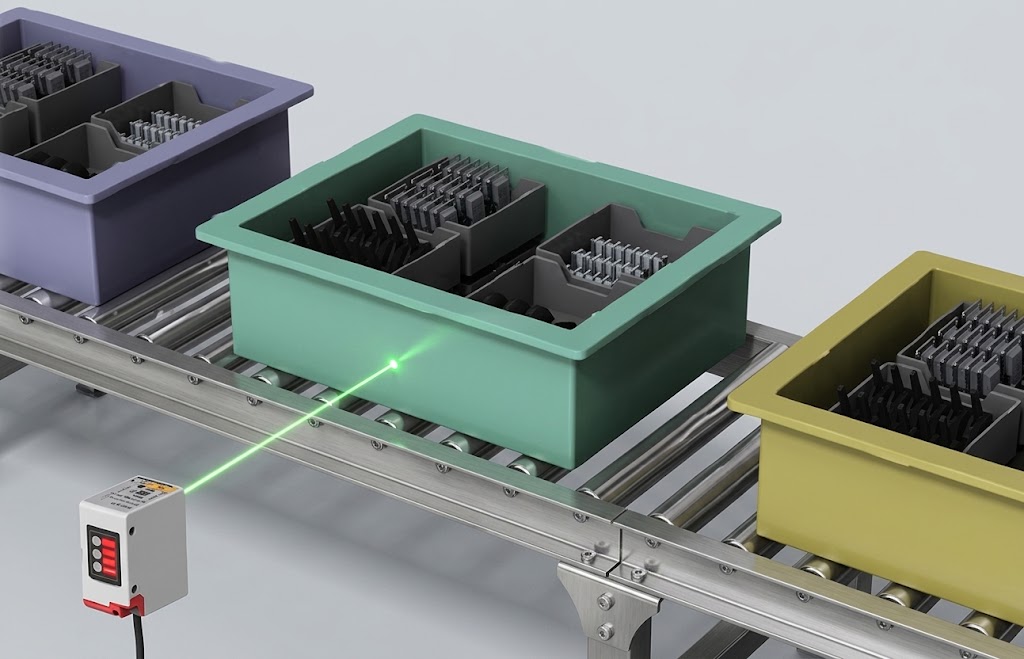
In logistics, you can use a color sensor for conveyor boxes to distinguish boxes by color and trigger different sorting or routing actions. CR7’s longer detection distance can be useful when the sensor cannot be installed directly next to the conveyor target.
For assembly and processing, the sensor can identify different product models based on color differences. This can help your automation system confirm whether the correct component has reached a workstation before the next process begins.
Other potential applications include:
- Packaging and printing equipment
- Product sorting and assembly lines
- Conveyor-based logistics systems
- Electronic component manufacturing
- New energy equipment
- Semiconductor production equipment
- Automated inspection systems
Why Choose Huayifeng Color Sensors?
When you evaluate a photoelectric color sensor, technical specifications are only one part of the decision. Supplier capability, quality management, product certification, and application support also affect long-term deployment.
Huayifeng was established in 2009 and is based in Shenzhen, China. The company holds a portfolio of 100+ patents, design patents, and software copyrights and has been recognized as a National High-Tech Enterprise and a national “Little Giant” enterprise.
Huayifeng has also obtained:
- ISO 9001 quality management certification
- ISO 14001 environmental management certification
- ISO 45001 occupational health and safety certification
- Applicable CE compliance documentation for relevant product models
- RoHS compliance documentation for relevant product models
The company integrates product design, evaluation, manufacturing, sales, and application support. This enables you to discuss both standardized sensor selection and customized requirements with the same supplier.
FAQ
1. What is a color sensor used for?
A color sensor detects color differences or color marks on products and materials. Common applications include packaging machines, product sorting, assembly inspection, and conveyor systems.
2. What is the difference between CR5H, CR6, and CR7?
CR5H focuses on compact color mark and color detection. CR6 adds intelligent digital functions and flexible fiber optic configurations, while CR7 uses white LED technology and offers detection distances up to 500 mm on selected models.
3. Can a color sensor work with automated production equipment?
Yes. Huayifeng’s CR Series is designed for industrial automation applications and provides features such as NPN/PNP outputs, selectable detection modes, digital displays, timers, and protection circuits depending on the model.
Conclusion
Selecting the right Color sensor can improve product identification, color mark detection, and inspection reliability across automated production lines. With CR5H, CR6, and CR7 options, Huayifeng gives you different combinations of RGB or white LED technology, detection distances, optical configurations, and control functions for packaging, logistics, assembly, and industrial automation.
CTA
If you are selecting a color sensor for a new machine or replacing an existing sensor, send Huayifeng your target material, sensing distance, installation space, PLC output requirement, application scenario, or current sensor model. The application team can recommend a suitable CR Series model and provide selection, technical, and applicable compliance documentation.