




When you need reliable object detection on an automated production line, a photoelectric laser sensor can help you detect small or distant targets with greater precision. However, inconsistent detection distance, large light spots, ambient light interference, and limited installation flexibility can affect production efficiency.
The ES200 Series Laser Sensor from Huayifeng addresses these requirements with three detection methods: diffuse reflective, specular reflective, and through-beam. Depending on your application, you can select a detection distance of up to 30m, use a small laser spot for precise target detection, and switch between Light-ON and Dark-ON operation modes.
Why Choose a Photoelectric Laser Sensor for Industrial Automation?
In industrial automation, you often need to detect parts, plates, packages, or other opaque objects without physical contact. A laser-based photoelectric sensor provides a focused detection point, making it suitable for applications where conventional detection methods may struggle with small targets or longer distances.
The ES200 Series supports applications across several industries, including:
- Mechanical processing: Detect the presence of metal components.
- Woodworking: Detect thin plates and workpieces.
- Logistics: Detect goods moving on sorting conveyor lines.
- Industrial automation: Monitor the presence or absence of objects during automated processes.
- Manufacturing: Support non-contact object detection on production equipment.
Huayifeng has supplied industrial sensor products since 2009 and integrates R&D, production, sales, and application support. The company serves automation equipment manufacturers and customers in industries such as new energy, semiconductors, and electronic manufacturing.
ES200 Photoelectric Laser Sensor Detection Options
Different production systems require different sensing methods. The ES200 Series provides three optical working principles, allowing you to select the configuration according to target material, distance, and installation conditions.
| Detection Type | Model Example | Detection Distance | Typical Application |
|---|---|---|---|
| Diffuse Reflection | ES201-D300N / ES201-D300P | 300mm | Small parts and nearby objects |
| Specular Reflective | ES201-R10MN / ES201-R10MP | 10m | Longer-distance object detection |
| Through-Beam | ES201-T30MN / ES201-T30MP | 30m | Conveyor and long-distance detection |
The laser source operates at 650nm, while the laser is specified as Class 1. The series also offers NPN and PNP output configurations, giving you greater flexibility when integrating the sensor with industrial control systems.
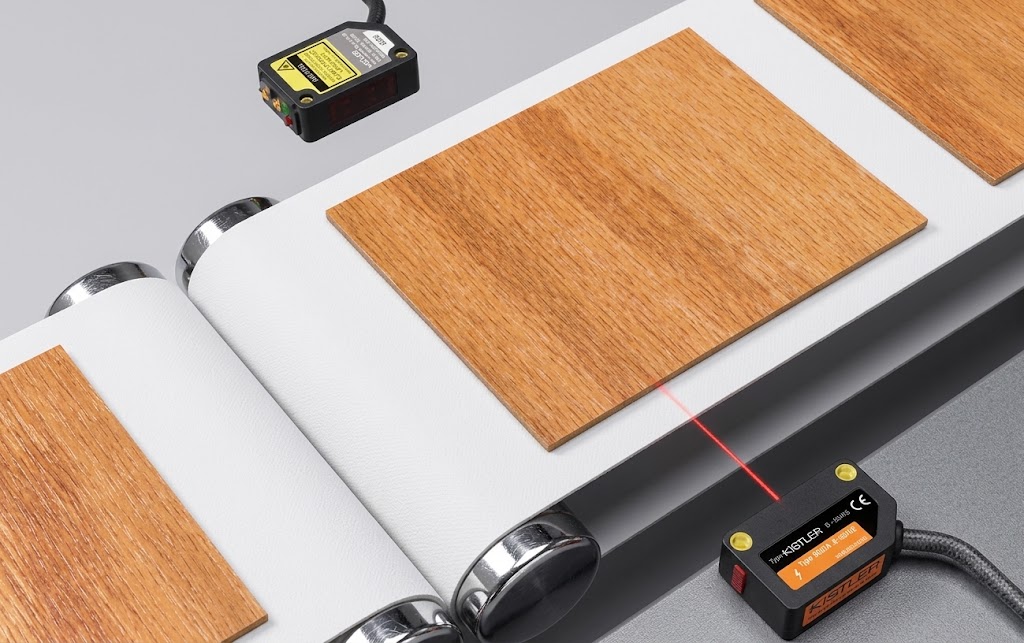
High-Precision Detection with a Small Laser Spot
A key advantage of the ES200 Series is its compact laser spot. The diffuse reflective model provides a spot size of approximately 1 × 2.5mm at 300mm, which supports detection of relatively small targets.
For longer-distance applications, the specular reflective version provides approximately 18 × 21mm at 10m, while the through-beam version reaches 47 × 21mm at 30m.
The sensor also includes an adjustable sensitivity potentiometer. You can therefore adapt detection sensitivity to different installation environments rather than relying on a fixed setting.
Key Technical Features
- Detection distance up to 30m
- 650nm laser light source
- Class 1 laser specification
- Diffuse reflective, specular reflective, and through-beam options
- NPN and PNP output versions
- Light-ON / Dark-ON switching
- Response time of less than 1ms or 2ms, depending on model
- 12–24V DC ±10% power supply
- IP64 protection rating
- Surge, short-circuit, and reverse-polarity protection
- Operating temperature from -10°C to +55°C
- 2m three-core cable connection
How to Select the Right Industrial Photoelectric Laser Sensor
You can follow these steps before selecting an ES200 configuration:
- Identify the target: Determine whether you need to detect metal parts, thin plates, packages, or another opaque object.
- Measure the detection distance: Select the 300mm, 10m, or 30m configuration according to the actual installation distance.
- Choose the optical principle: Use diffuse reflection for nearby targets, specular reflection for suitable reflective applications, or through-beam detection for long-distance sensing.
- Confirm the output type: Select NPN or PNP according to your PLC or control system.
- Check environmental conditions: Confirm temperature, ambient illumination, installation space, and IP requirements.
- Adjust sensitivity: Use the built-in potentiometer to optimize detection performance after installation.
This process helps you avoid selecting a sensor based only on detection distance while overlooking wiring, target characteristics, or control-system compatibility.
Huayifeng E-E-A-T and Quality Credentials
When you source an industrial photoelectric laser sensor, technical performance is only one part of the evaluation. You also need to consider manufacturing capability, quality management, engineering expertise, and long-term supplier reliability.
Huayifeng was established in 2009 in Shenzhen, China, and has accumulated nearly 100 patents covering technologies such as photoelectric sensor calibration, interference signal removal, through-beam sensor manufacturing, focusing devices, and ultra-thin photoelectric devices.
The company has obtained National High-Tech Enterprise and Specialized and Innovative Enterprise qualifications. Its management systems include:
- ISO 9001 Quality Management System
- ISO 14001 Environmental Management System
- ISO 45001 Occupational Health and Safety Management System
- CE certification for products
- Compliance with the EU RoHS directive
These documented credentials provide useful evidence when you evaluate Huayifeng as a photoelectric laser sensor manufacturer in China.
FAQ
What is a photoelectric laser sensor used for?
A photoelectric laser sensor uses laser light to detect objects without physical contact. The ES200 Series can detect metal parts, thin plates, and goods on conveyor lines in industrial environments.
How far can the ES200 Series detect objects?
The maximum specified detection distance is 30m for the through-beam configuration. The diffuse reflective model reaches 300mm, while the specular reflective model reaches 10m.
Can I choose NPN or PNP output?
Yes. The ES201 Series includes both NPN and PNP versions. You can select the output configuration according to your PLC, controller, and automation equipment requirements.
Conclusion
Selecting the right photoelectric laser sensor requires more than comparing detection distance. You should consider the detection principle, target size, output configuration, response time, environmental conditions, and installation requirements. With three detection methods, a maximum detection distance of 30m, adjustable sensitivity, NPN/PNP options, and industrial certifications, the ES200 Series gives you a flexible solution for automated object detection. Huayifeng combines sensor R&D, manufacturing, application support, and documented quality systems to support industrial automation projects in mechanical processing, woodworking, logistics, new energy, semiconductor, and electronic manufacturing applications.
Get the Right Sensor Configuration
If you are selecting a sensor for a new automation project, provide Huayifeng with your target object, detection distance, installation method, PLC output requirement, and working environment. The technical team can then help you determine the appropriate ES200 model and detection method for your application.