


Nowadays, modern factories, automated guided vehicles, mobile robots, transfer equipment, and robotic workstations require more than simple object detection. They require reliable area monitoring, configurable protection zones, and safety-related integration with the machine control system.
HUAYIFENG designed the RLD Series Safety Laser Scanner for industrial area protection and AGV obstacle detection. In addition, based on TOF laser ranging technology, the RLD Series creates configurable scanning areas around machines, vehicles, and automated work zones to help reduce collision risk and support safer industrial operation.
For machine builders, automation integrators, and smart warehouse projects, the RLD Series combines wide-angle scanning, flexible zone configuration, and functional safety capability to support demanding safety and area-detection applications.
Functional Safety Certification for RLD Safety Laser Scanner
According to the functional safety certificate displayed by HUAYIFENG, engineers assessed the RLD Series safety laser scanners against IEC 61508, ISO 13849, and IEC 61326-3-2 requirements. Furthermore,the certificate identifies the RLD Series as SC 2 / SIL 2 capable and a Type 4 element, subject to proper integration into the complete safety function.
This certification supports RLD scanners in safety-related systems when engineers correctly select, install, wire, configure, and validate the product with the machine control system, safety relay, safety PLC, and risk assessment requirements.
Key Capabilities of the RLD Series
- TOF laser ranging technology for distance-based object detection
- Wide-area laser scanning for industrial safety and area monitoring
- Configurable protection zones and warning zones for different equipment layouts
- Suitable for AGV collision avoidance, mobile robot safety, machine access monitoring, and smart warehouse protection
- Model-specific detection ranges and zone settings for different application distances
- Engineers can integrate the RLD Series with safety-related control systems according to project risk assessments.
These features allow you to configure safety areas according to different machine layouts and operating conditions.
Protection Zone, Warning Zone, and Detection Distance
A safety laser scanner project should clearly distinguish between protection zones, warning zones, and maximum detection distance. These are not the same value and should not be mixed in technical communication.
|
Term |
Meaning | Why It Matters |
| Protection Zone | The safety-related area that triggers a protective response when an object or person enters the defined zone. |
Used for safety-related control logic and machine stop requirements. |
| Warning Zone | A larger or separate area that slows down equipment, triggers alarms, or prepares a control response before objects reach the protection zone. |
Useful for AGV speed reduction and early collision avoidance. |
| Maximum Detection Distance | The maximum ranging or detection capability under specified conditions. |
Should not be used as a direct replacement for certified protection range. |
Typical Applications
AGV and AMR Collision Avoidance
For example,for AGVs and autonomous mobile robots, RLD scanners can be configured to monitor the travel direction and surrounding area.. Warning zones can support speed reduction or alerts, while protection zones can support safety-related stop functions depending on the validated control architecture.
Robotic Workstations
In robotic cells and automated workstations, RLD scanners can help monitor restricted access areas and reduce the risk of unexpected entry into hazardous zones when integrated with suitable safety control devices.
Smart Warehousing and Material Handling
Similarly,in warehouses, conveyor transfer areas, automated forklifts, and material handling systems, configurable area monitoring helps reduce collision risk and supports stable operation in dynamic industrial environments.
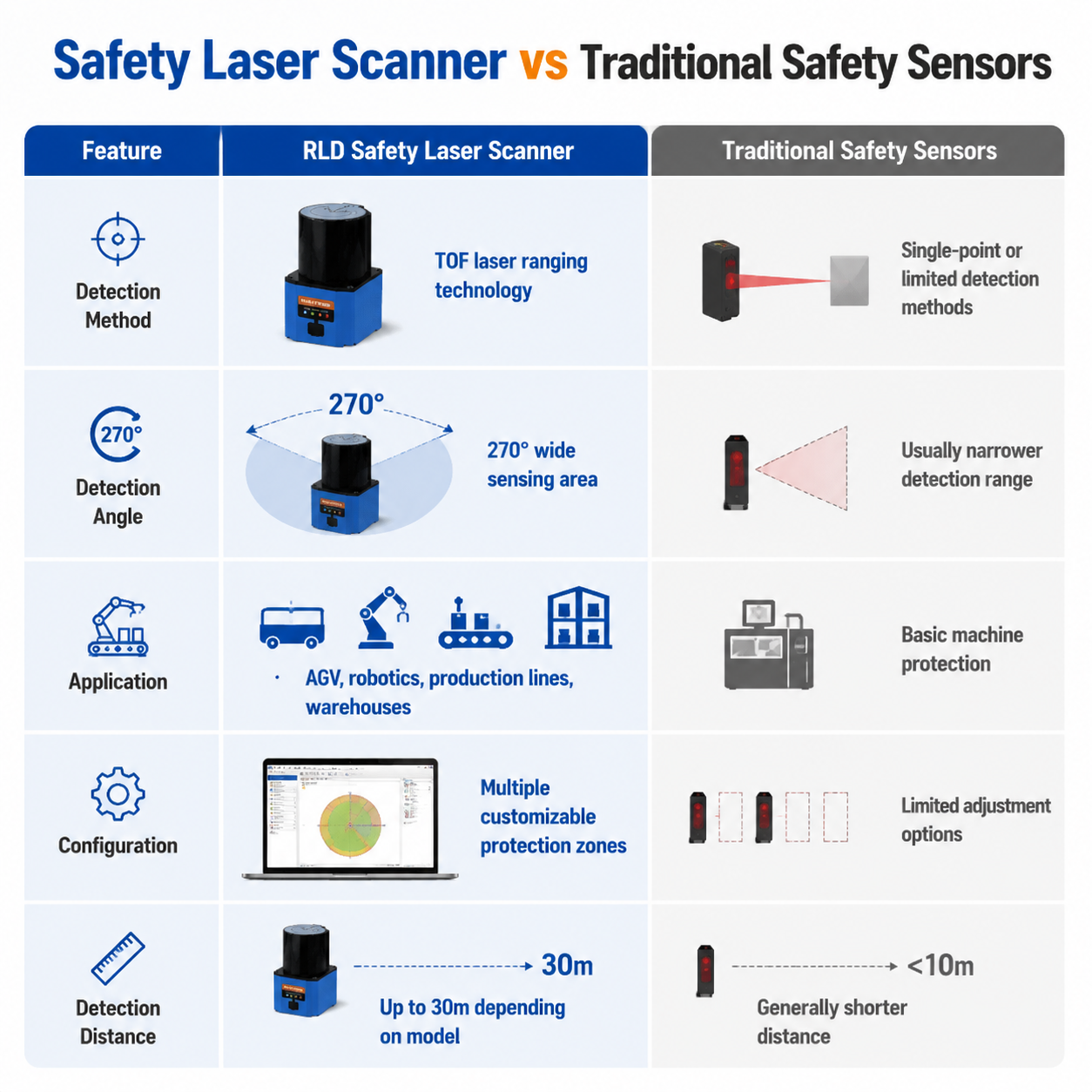
RLD Safety Laser Scanner vs Traditional Safety Sensors
| Feature | RLD Safety Laser Scanner | Traditional Point Sensors |
|---|---|---|
| Detection Method | TOF laser ranging with configurable scanning areas | Single-point or limited detection method |
| Coverage | Wide-area monitoring for complex machine or vehicle zones | Narrower or fixed sensing direction |
| Configuration | Protection and warning zones can be configured according to application needs | Limited adjustment and zone flexibility |
| Application Fit | AGV, AMR, robotics, automated lines, smart warehouses | Basic object detection or simple machine guarding |
| Project Requirement | Requires engineers to complete safety calculation, installation, and validation | Usually simpler but less flexible for dynamic environments |
The RLD Series provides greater flexibility for complex automation environments where multiple protection areas are required.
How to Select the Right RLD Safety Laser Scanner
- Define the application: AGV travel path, robot cell, machine opening, warehouse route, or production-line access area.
- Confirm the required protection zone and warning zone dimensions, instead of using only the maximum detection distance.
- Check the machine stopping time, vehicle speed, safety distance, and risk assessment requirements.
- Confirm the required control architecture, including safety relay, safety PLC, output wiring, and reset logic.
- Select the correct RLD model according to detection angle, zone configuration, distance requirement, environmental conditions, and certification scope.
- Validate the final safety function after installation and configuration.
FAQ
1. What is a safety laser scanner used for?
A safety laser scanner monitors a defined area around machines, AGVs, robots, or automated work zones. It can detect objects or people entering configured zones and support safety-related control responses when properly integrated into the complete machine safety system.
2. Is the RLD Series suitable for AGV safety applications?
Yes. The RLD Series is designed for area monitoring and AGV obstacle detection applications. Final model selection should be based on the required detection range, protection zone, warning zone, vehicle speed, stopping distance, and control system architecture.
3. Does maximum detection distance equal protection range?
No. Maximum detection distance, warning zone, and certified protection zone should be treated separately. For safety-related applications, the protection zone and final safety distance must be validated according to the complete machine or vehicle safety function.
4. Can the RLD scanner be used alone as a complete safety system?
No. A safety laser scanner is one part of a complete safety function.Engineers should integrate it with compatible safety control devices and validate the system according to the machine risk assessment, safety manual, wiring, stopping time, and installation conditions.
Conclusion
Overall,the HUAYIFENG RLD Series Safety Laser Scanner provides a configurable area-detection solution for AGV protection, robotic workstations, automated production lines, and smart warehousing. With TOF laser ranging, wide-area scanning, configurable protection and warning zones, and functional safety capability, RLD helps machine builders and automation integrators build safer and more flexible industrial automation systems.
Contact HUAYIFENG to confirm the right RLD model, certified configuration, protection zone, warning zone, safety control architecture, and integration requirements for your project.